
PCLinuxOS Persistence: This guide explains how persistence works with modern versions of PCLinuxOS when running from a bootable USB drive. Persistence allows your personal files, installed applications, and system settings to be saved directly to the USB so they are restored automatically on every reboot.
Unlike older releases, current PCLinuxOS versions no longer use the legacy Kusbhome utility. Persistence is now handled through a writable overlay or persistent storage file created during USB setup.
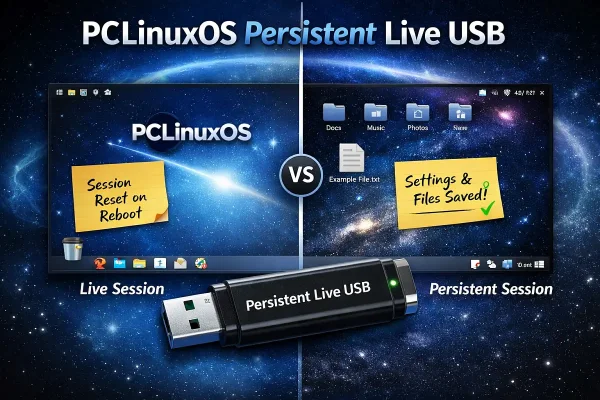
PCLinuxOS Persistence on a Bootable USB
When running PCLinuxOS from a Live USB, the system normally loads into memory and any changes are lost after shutdown. Persistence solves this by creating a writable storage area on the USB device where changes are stored.
How persistence works depends entirely on how the USB was created.
- Some USB creation tools automatically create a persistent overlay
- Some allow you to choose a persistence file size during setup
- Others do not support persistence at all
For best results, use a USB creation tool that explicitly supports persistent storage.
Using YUMI or Universal USB Installer
If you created your PCLinuxOS USB using YUMI or Universal USB Installer (UUI), persistence support depends on the distribution configuration included with the tool.
When supported, you will typically see an option to allocate space for persistence during setup.
- Download the latest PCLinuxOS ISO.
- Launch YUMI or UUI.
- Select your USB Drive
- Choose PCLinuxOS from the distribution list.
- If persistence is available, move the slider to choose the size of the persistent storage file.
- Complete the USB creation process and boot from USB.
The persistent file will be stored on the USB drive and used automatically at boot.
How the Persistent Storage Is Used
The persistence file or overlay stores:
- Installed software packages
- System configuration changes
- User files saved in your home directory
- Desktop preferences and personalization
Each time you boot from the USB, the system merges the read only ISO filesystem with your writable persistent storage. Any changes you make are written back to the USB.
Manual Persistence Setup (Advanced)
If your chosen method does not automatically create persistent storage, advanced users can manually configure persistence by:
- Creating an additional partition on the USB drive
- Formatting it with a Linux filesystem such as ext4
- Adding the required boot parameters to enable a writable overlay
This method requires familiarity with partitioning tools and bootloader configuration.
Verify That Persistence Is Working
To confirm your PCLinuxOS USB is saving changes:
- Boot into PCLinuxOS from your USB drive
- Create a test file in your home directory
- Reboot the system
- Boot again from the same USB
If the file remains after reboot, persistence is functioning correctly.
Important Notes
- Use a USB drive with sufficient free space. 16GB or larger is recommended.
- Faster USB 3.0 drives significantly improve performance.
- On exFAT formatted multiboot drives, persistence may be stored as a container file rather than a dedicated partition.
- Not all PCLinuxOS editions or kernels support persistence the same way.
Once properly configured, your PCLinuxOS bootable USB becomes a fully portable Linux system where your changes are automatically saved between sessions.