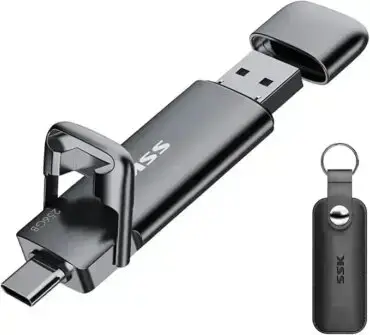
Create a RIP Linux (Recovery Is Possible) bootable USB for system recovery, data recovery, disk maintenance, and troubleshooting. RIP Linux is a lightweight, Slackware-based Linux rescue environment that can run directly from bootable media without being installed to the computer. Create the USB from Windows using YUMI, or write the ISO directly to a USB drive from Linux or macOS using dd.
RIP Linux is no longer actively maintained, with the last RIPLinuX release dating back to 2011. Despite its age, the small recovery environment can still be useful for certain offline recovery and maintenance tasks, particularly when you need a compact Linux rescue system.
RIP Linux Bootable USB Recovery Environment
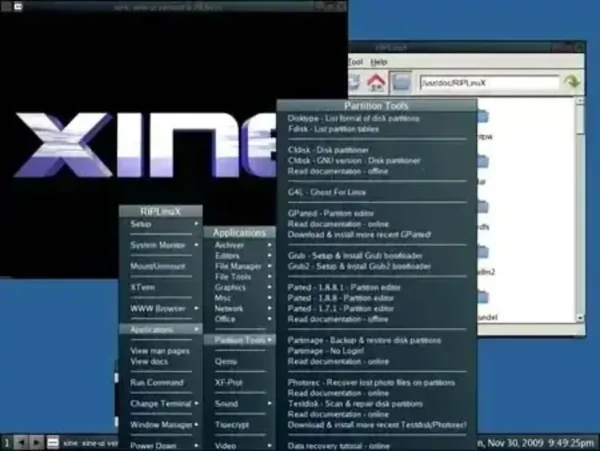
Important: RIP Linux is a discontinued project and is no longer regularly updated. The latest RIPLinuX release available from the project's SourceForge files is version 11.7, released in 2011. For modern hardware and current recovery tools, consider an actively maintained alternative such as SystemRescue.
What is RIP Linux?
RIP Linux, short for Recovery Is Possible, is a compact Slackware-based Linux rescue, backup, and maintenance system originally created by Kent Robotti.
It was designed to boot independently of the operating system installed on a computer, providing a portable environment for working on disks, filesystems, partitions, and other system-recovery tasks.
RIP Linux can be useful for:
- Data recovery and file rescue
- Partition management and disk maintenance
- Filesystem troubleshooting
- Boot and system recovery
- Backup and file transfer
- Offline system maintenance
Because it runs from bootable media, RIP Linux can be useful when the operating system installed on the computer will not boot normally.
RIP Linux Recovery Tools
RIP Linux was built as a small rescue environment containing a variety of utilities for recovering and maintaining computer systems.
Some of the tools and capabilities associated with RIP Linux include:
- TestDisk for partition recovery and filesystem-related problems
- PhotoRec for recovering files from storage media
- GParted for graphical partition management
- fdisk, cfdisk, and parted for partition management
- Midnight Commander for file management from the command line
- GRUB and LILO for working with bootloader configurations
- rsync, scp, ssh, and wget for file transfer and network-related tasks
The project was designed to support a wide range of filesystem types and provide a collection of utilities for system recovery, backup, and maintenance.
RIP Linux Project Information
Project: RIPLinuX (Recovery Is Possible)
Original developer: Kent Robotti
Base: Slackware
Status: Discontinued
Latest RIPLinuX ISO: 11.7
Latest release: 2011
Project page: RIPLinuX on SourceForge
The RIPLinuX project files currently list RIPLinuX-11.7.iso as the latest release, with a size of approximately 143 MB.
What You'll Need
To create a RIP Linux recovery USB, you'll need:
- A Windows, Linux, or macOS computer
- A USB flash drive, 1 GB or larger recommended
- The RIPLinuX 11.7 ISO
- YUMI if creating the USB from Windows
ddif writing the ISO directly from Linux or macOS
Warning: Writing an ISO directly to a USB device with dd will overwrite the selected device. Carefully verify the USB device name before running the command.
Create a RIP Linux Bootable USB in Windows
Windows users can use YUMI to add RIP Linux to a bootable USB drive.
YUMI is particularly useful if you want to keep RIP Linux alongside other Linux distributions, recovery environments, and bootable utilities on the same USB drive.
- Download the RIPLinuX 11.7 ISO.
- Download and run YUMI.
- Insert your USB flash drive and select it from the YUMI drive list.
- Choose RIP Linux (Recovery Distro) from the distribution list.
- If RIP Linux is not listed, select Try Unlisted ISO
- Browse to the
RIPLinuX-11.7.isofile. - Click Create to add RIP Linux to the USB drive.
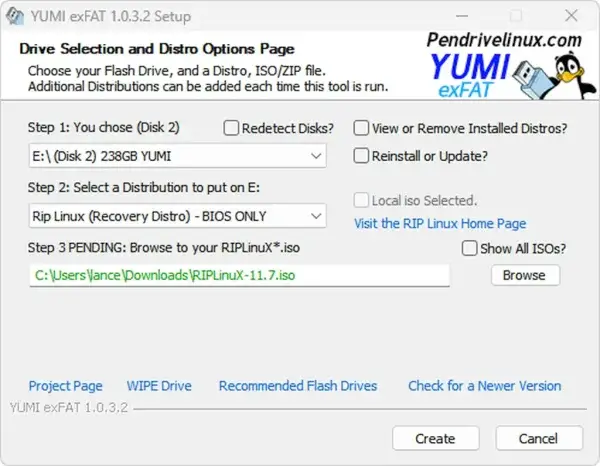
Once YUMI finishes copying the files, RIP Linux will be available from the YUMI boot menu.
Boot RIP Linux from USB
After creating the USB:
- Restart the computer.
- Open the system's BIOS or Boot Menu.
- Select the USB flash drive as the boot device.
- Choose RIP Linux from the YUMI boot menu.
RIP Linux will then start from the USB drive without requiring installation to the computer's internal storage.
Create a RIP Linux USB from Linux
Linux users can write the RIP Linux ISO directly to a USB drive using dd.
1. Identify the USB Drive
Insert the USB flash drive and run:
lsblk
Identify the correct USB device, such as:
/dev/sdX
Do not select a partition such as /dev/sdX1.
Make sure you have identified the correct device before continuing. The dd command will overwrite the selected device.
2. Write RIP Linux to the USB
Run:
sudo dd if=RIPLinuX-11.7.iso of=/dev/sdX bs=4M status=progress oflag=sync
Replace /dev/sdX with the actual device name of your USB drive.
When the operation is complete, eject the USB drive:
sudo eject /dev/sdX
You can then reboot the computer and select the USB drive from its boot menu.
Create a RIP Linux USB from macOS
macOS users can also write the RIP Linux ISO directly to a USB drive with dd.
1. Identify the USB Drive
Insert the USB drive and open Terminal.
Run:
diskutil list
Find the USB drive in the list. For example:
/dev/disk2
Be certain that you have identified the correct disk before continuing.
2. Unmount the USB Drive
Run:
diskutil unmountDisk /dev/disk2
Replace disk2 with the correct disk identifier.
3. Write the ISO to USB
Use the raw disk device when writing the image:
sudo dd if=~/Downloads/RIPLinuX-11.7.iso of=/dev/rdisk2 bs=4m
Replace rdisk2 with the corresponding raw device for your USB drive.
4. Eject the USB Drive
When dd finishes, eject the drive:
diskutil eject /dev/disk2
The USB drive can now be used to boot a compatible computer.
Using RIP Linux for System Recovery
Once RIP Linux has booted, you can use its included utilities to work on the computer without relying on the installed operating system.
Depending on the recovery task, you can use the environment to:
- Inspect and manage disk partitions
- Recover lost partitions or files
- Check and troubleshoot filesystems
- Copy important files to another storage device
- Transfer files across a network
- Investigate bootloader problems
- Perform other offline maintenance tasks
This makes RIP Linux useful as an independent Linux recovery environment when the operating system on the internal drive is damaged or unable to boot.
RIP Linux vs. Modern Linux Recovery Tools
RIP Linux remains interesting because of its small size and focus on system recovery. However, it is an old project and has not received current development for many years.
For older computers or situations where you specifically need the RIP Linux environment, it can still be worth keeping on a recovery USB.
For modern computers, an actively maintained project such as SystemRescue is generally a better choice. SystemRescue continues to receive updates and provides current kernels and recovery utilities, along with support for installing the environment on USB drives.
SystemRescue currently includes tools for disk and partition management, data recovery, NTFS access, memory testing, backups, and network recovery tasks.
RIP Linux on a Multiboot USB
One advantage of using YUMI is that RIP Linux does not have to occupy an entire USB drive.
You can add RIP Linux alongside other Linux distributions, recovery environments, diagnostic tools, and bootable utilities.
A multiboot recovery USB could contain:
- RIP Linux
- SystemRescue
- GParted Live
- Clonezilla
- Linux live distributions
- Other diagnostic and recovery utilities
This lets you keep several Linux recovery and maintenance environments on one USB drive instead of maintaining a separate flash drive for each ISO.
RIP Linux Bootable USB Summary
RIP Linux is a compact Slackware-based Linux recovery environment that was designed for system recovery, backup, disk maintenance, and troubleshooting.
Although the project is discontinued, the small RIPLinuX ISO can still be useful in certain recovery situations, especially when you want a lightweight Linux environment that runs independently of the installed operating system.
You can create a RIP Linux bootable USB in Windows using YUMI, or write the ISO directly to a USB drive from Linux or macOS using dd.
For a modern Linux recovery USB with current hardware and software support, SystemRescue is the better choice.